
The Pillars of Healthy Eating
The simple foundations that make healthy eating easier — in real life.
NUTRITION & HEALTH
1/2/20263 min read
Healthy eating often sounds complicated.
Too many rules. Too many opinions. Too many “you should” statements.
But at its core, healthy eating is not a diet.
It’s a framework that gives you clarity — without stress, perfection, or restriction.
In this article, I’ll walk you through the key pillars of healthy eating — not in theory, but in a way that actually fits into real life.
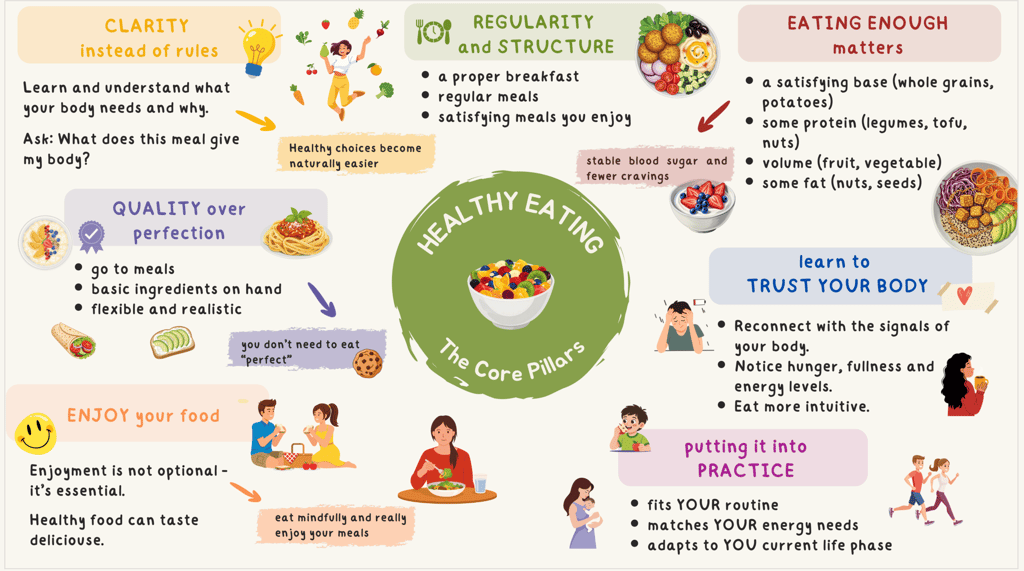
1. Clarity instead of rules
One of the most important pillars of healthy eating is understanding.
Not:“I’m not allowed to eat this.”
But: “I understand why my body needs certain foods.”
When you understand:
what gives you energy
what keeps you full
what stabilizes your blood sugar
… healthy choices become naturally easier.
🌿 Healthy eating only works long term when it makes sense — not when it relies on willpower.
How to apply this in everyday life:
Focus on understanding, not on food rules
Ask: What does this meal give my body? instead of Is this allowed?
2. Regularity and structure
Your body thrives on consistency.
Not in the sense of rigid meal times, but in:
regular meals
enough energy throughout the day
avoiding extreme ups and downs
Many cravings aren’t caused by “bad food choices” but by:
long gaps between meals
meals that don’t satisfy
not eating enough earlier in the day
How to apply this in everyday life:
Start your day with a real meal, not just coffee
Aim for 2–3 proper meals per day
Eat before you feel completely drained or ravenous


3. Feeling full is not the enemy
A central pillar of healthy eating is satisfaction.
Feeling full means:
stable blood sugar
fewer cravings
a calmer relationship with food
Healthy eating is not about eating “light” — it’s about eating enough.
How to apply this in everyday life:
Make sure your meals include:
a satisfying base (e.g. oats, whole grains, legumes)
a protein source
some fat
volume (vegetables and/or fruit)
🌿 When meals leave you satisfied, control becomes unnecessary.
4. Quality over perfection
Healthy eating does not mean:
cooking everything from scratch
eating perfectly “clean”
doing everything right all the time
It means:
mostly nourishing
mostly balanced
mostly realistic for your life
Frozen vegetables, simple meals, and repeating favorite dishes are not compromises — they are part of sustainable healthy eating.
How to apply this in everyday life:Build a small set of go-to meals
Keep basic ingredients on hand
Allow practical, flexible solutions
5. Enjoyment is part of health
Food is more than fuel.
Enjoyment is not optional — it is essential.
When pleasure is missing, we often experience:
inner resistance
feelings of deprivation
loss of control later on
How to apply this in everyday life:
Allow sweet treats without compensation
Eat mindfully, not distracted
🌿Remember: enjoyment and health are not opposites
6. Implementation matters more than knowledge
Most people already know what might be healthy.
The real challenge isn’t information — it’s integration into daily life.
Healthy eating works when it:
fits your routine
matches your energy needs
adapts to your current life phase
🌿 There is no one “perfect” way to eat — only a structure that works for you.


7. Listening to your body builds confidence
Healthy eating isn’t about constantly questioning yourself.
It’s about learning to trust your body’s signals again.
When you reconnect with hunger, fullness, and energy levels,
food decisions become calmer and more intuitive.
This isn’t intuition without structure — it’s awareness built on understanding and consistency.
How to apply this in everyday life:
Notice hunger before it becomes extreme
Pay attention to energy and focus after meals
Adjust portions and timing without judgment
🌿 Self-trust grows through repetition, not perfection.
Final thoughts: Healthy eating is a system, not a set of rules
The pillars of healthy eating are:
understanding instead of restriction
structure instead of chaos
satisfaction instead of control
quality instead of perfection
learn to listen to your body
enjoyment instead of guilt
When these pillars are in place, healthy eating becomes:
calmer
easier
sustainable
🌿 And that’s the goal.
Want to go deeper?
Understanding these principles is the first step.
But knowing what matters and actually applying it in daily life are two different things.
Inside my Plant-Based Starter System, I guide you step by step:
• how to build simple, balanced meals
• how to stop overthinking food decisions
• how to make healthy eating feel natural and sustainable
→ So you can turn this knowledge into something that actually works in your everyday life.
Without overthinking every decision.
Stay in touch
Questions or thoughts?
I'd love to hear from you.
© 2026 Eat Healthy with Johanna
info@eatwellwithjohanna.com